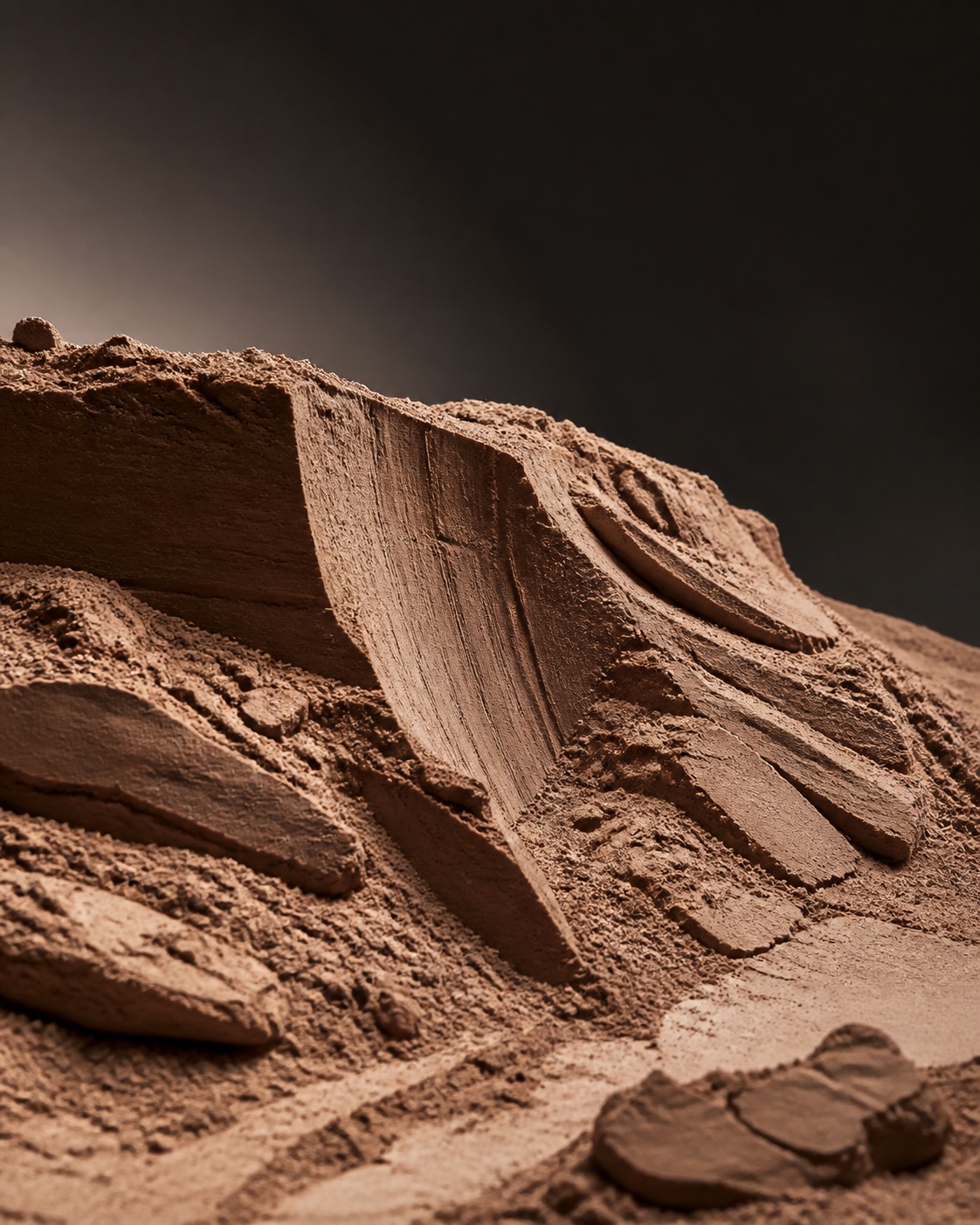
Rhassoul—also written Ghassoul—is not simply a brown clay with an evocative origin story. It is a magnesium-rich clay material associated with a specific Moroccan deposit, a distinctive mineralogical profile and centuries of cleansing use. Understanding all three is the first step toward specifying it honestly.
A name rooted in washing, not volcanic lava
The names Rhassoul and Ghassoul are transliterations of the same Moroccan term, commonly connected to the Arabic root for washing. “Moroccan Lava Clay” is the recognised cosmetic ingredient name used in international nomenclature; it should not be read as a literal geological claim that the material is solidified lava.
That distinction matters. Good ingredient storytelling starts with what the material is, then adds cultural context. It does not turn a nomenclature convention into invented geology.
Commercial names include Rhassoul, Ghassoul and Moroccan clay. The batch identity and supplier documentation remain the deciding references.
A Moroccan deposit with an unusual mineral signature
Published mineralogical work describes Ghassoul as a magnesium-rich, stevensite-dominant clay with accessory minerals that can include quartz, dolomite and calcite. The cited deposit is associated with the Moulouya basin on the eastern side of Morocco’s Middle Atlas. Geological literature links its formation to the transformation of magnesium- and silica-rich material in an ancient lacustrine environment.
This does not mean every commercial powder is chemically identical. Natural minerals vary with seam, preparation and lot. “Moroccan origin” and a technical name are therefore the beginning of qualification—not a substitute for batch documentation.
From hammam practice to documented raw material
Rhassoul has long been prepared with water and used in Moroccan washing and hammam practice, particularly for hair and skin cleansing. Its passage into modern cosmetics did not erase that heritage; it changed the proof expected around it. A professional buyer now needs the cultural story and a declared INCI, CAS, particle size, microbiological context, contaminant data, packaging and traceability.
The first scientific chemical description cited by later reviews dates to the nineteenth century. Research then expanded from mineral identification to surface chemistry and adsorption. Those studies help explain why formulators find the material technically interesting, but they do not by themselves substantiate finished-product cosmetic claims.
What “authentic” should mean to a buyer
Authenticity should be made operational. Ask for declared Moroccan origin, a stable commercial and INCI identity, batch-linked documents, an appearance range, storage conditions and a route from sample to repeat supply. If the ingredient is destined for an EU cosmetic, the finished-product responsible person must still complete the safety and compliance work required for that formula.
The strongest origin story is one that survives procurement: named material, documented lot, known pack, clear supplier and a sample your laboratory can actually test.
Sources & technical context
- 01Tokarský, “Ghassoul – Moroccan clay with excellent adsorption properties”, Materials Today: Proceedings (2018)
- 02Interfacial electrochemical properties of natural Moroccan Ghassoul, Heliyon (2020)
- 03ALT’S Rhassoul technical sheet (2026)
Historical and geological context describes published Ghassoul literature. Contractual specifications and the certificate of analysis for the supplied lot take precedence.