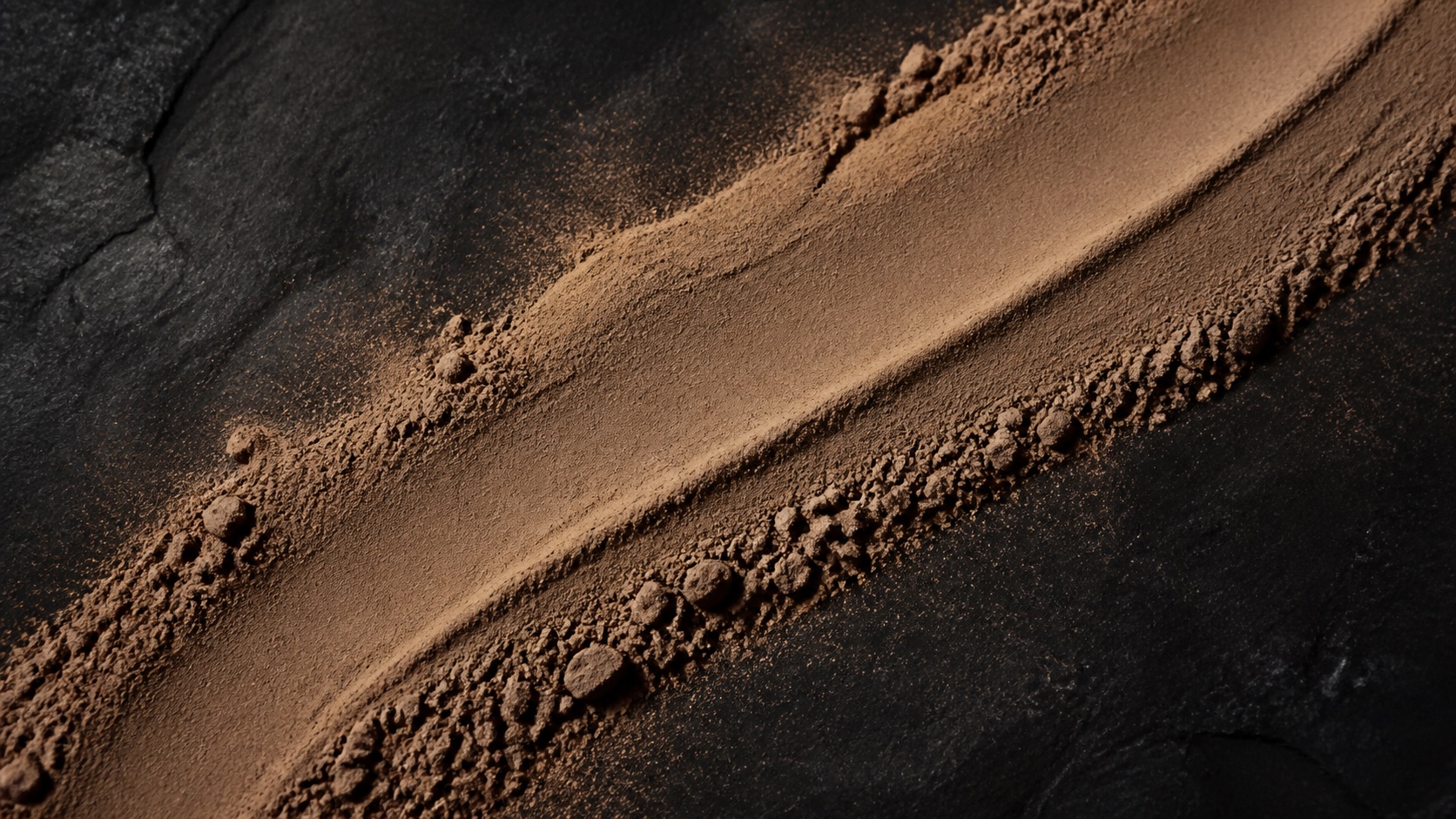
Rhassoul is valued for the way a mineral powder meets water, oil, soil and the sensory expectations of a cleansing ritual. Its useful properties are real formulation questions—not permission to promise “detox”, healing or universal suitability.
What the material can contribute
As a high-surface-area, magnesium-rich clay, Rhassoul can take up materials at its surface and build a characteristic wet paste. In a cosmetic system, that can support cleansing, oil-management, opacity, mineral colour, body and a distinctive after-feel. The exact result depends on grade, dose, particle size, liquid phase, mixing sequence and the rest of the formula.
Published adsorption research is mostly not a cosmetic efficacy study. It demonstrates surface interaction under defined laboratory conditions; it does not prove that a facial mask “removes toxins”. Translate the science into testable formulation hypotheses, then substantiate the finished product claim you actually make.
“Helps remove excess surface oil” can be studied. “Detoxifies the skin” is broad, biologically loaded and usually unsupported by raw-material adsorption data.
Best practice when hydrating the powder
Add powder progressively to the liquid phase under controlled agitation, or pre-blend it with other dry powders before hydration. Record the water-to-powder ratio, mixing energy, rest time and temperature: clay systems can continue to wet and reorganise after the mixer stops.
Use clean equipment and avoid uncontrolled standing water. A dry mineral is not a preservative. Once water enters a product, the full microbiological strategy of the finished formula becomes relevant. For preserved ready-to-use products, conduct preservation efficacy and compatibility work on the final pack and process.
Manage dust, drag and removal
A pleasant mineral ritual can become a poor product if dust blooms during filling, the paste drags during application or the film becomes difficult to rinse. Control dust through process, pack choice and, where suitable, granulation or wetting aids. Tune slip with compatible humectants, emollients or polymers rather than assuming more water will solve every sensory issue.
Evaluate application on the intended body area, drying profile, cracking, rinse time, residue and after-feel. For hair, add wet-combing and particulate removal. For facial powders, consider foreseeable inhalation and eye exposure during dispensing.
The simple test plan that prevents vague claims
- Identity: colour, odour, appearance and batch documents.
- Process: dispersion time, lumping, dust and equipment clean-down.
- Performance: oil uptake, cleansing, spread, drying and rinse under a defined protocol.
- Stability: viscosity, separation, colour, odour, pack interaction and microbiology.
- Claims: connect every consumer-facing statement to appropriate finished-product evidence.
Sources & technical context
- 01Ghassoul adsorption review, Materials Today: Proceedings (2018)
- 02Surface behaviour of Moroccan Ghassoul in aqueous suspension, Heliyon (2020)
- 03EU Cosmetics Regulation — safety and product claims
- 04ALT’S Rhassoul technical sheet (2026)
This article is formulation guidance, not a finished formula or safety assessment. Suitability, use level, preservation and claims must be established for the intended product.